Hemingway's secretary little imagined she would become the mother of his grandchildren. Now Valerie Hemingway is on the stage with the musicians of the Buena Vista Social Club to recreate the writer's life in Cuba, writes Mark Fisher
THE YEAR is 1959 and 19-year-old Valerie Danby-Smith has left behind her Irish convent to work as an au pair in Madrid. She wants to be a journalist and takes the opportunity to file stories to the Irish Times and a local news agency. Her diligence means that when Ernest Hemingway shows up in town, the agency turns to her to get an interview.
For the young Danby-Smith, a voracious reader and lover of literature, to meet the great American author of For Whom The Bell Tolls is thrilling. At the same time, Hemingway is not at the very top of her list of favourite authors and she can afford to be relaxed. She has no intention of gushing over him.
Little does she realise her good fortune has only just begun. Having tracked down the 59-year-old novelist at lunch in his hotel, she gets him to agree to an interview the following day. Thanks to her friendship with Dublin's literary set – including one Brendan Behan – she inadvertently captures his imagination. He insists she should join him a few weeks later for the bullfighting in Pamplona. Before she knows it, he's asking her to spend the summer with him and his fourth wife, Mary, as a personal secretary.
It's a request that changes the course of her life. She spends the next 18 months accompanying Hemingway to Spanish bullfights, on journeys across Europe and back to his home in Cuba. It is at the author's funeral, following his suicide in 1961, that she meets his estranged son Gregory, the man who will become her husband and father of three of her children.
The story is extraordinary enough before she mentions her friendship with Norman Mailer, her pregnancy after a one-night stand with Brendan Behan and the discovery of Gregory's penchant for cross-dressing.

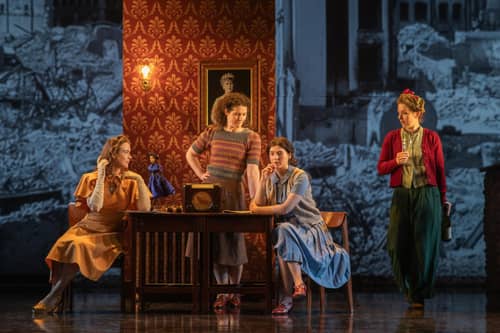
All this she recounts in compelling detail in her 2004 memoir, Running With The Bulls. Now she is returning to those stories in Hemingway's Havana, a Fringe show in which she will appear with the fabulous musicians from the famous Buena Vista Social Club.
"At the time it seemed perfectly ordinary, but in retrospect I feel I was very lucky," she says at her home in Montana. "Part of it was growing up in that time in Ireland where things were pretty uncertain and there wasn't much in the way of work. When I met Hemingway, I never thought of it as a career. I was willing to take any chance that came up."
What she offered Hemingway was a down-to-earth honesty. At a very young age, Valerie had been virtually abandoned by her parents and made to split her childhood between a Catholic boarding school and a hotel run by family friends. The unusual background stood her in good stead for what was to come. "I was used to all sorts of sets of different people," she says. "In that very odd hotel, the clientele were quite eccentric and interesting. Writers, painters, artists and singers were treated as members of the family. So I had that easy way with people who are artistic.
"A lot of people who wanted to be with Hemingway were American because he was an American icon, but I wasn't aware of this and didn't pay any attention to it, so he was always, in a teasing way, trying to get me to say nice things about him. People who wanted to be around him tended to be on the fawning side, but I had no vision that I would be there for a long time."
The impression she creates of Hemingway is of a magnetic figure, a man who, despite the depressive illness that led to his suicide, is forever at the centre of a great party. Valerie, now 68, says she never again met anyone with his charisma. "I thought he was a one-off," she says. "I knew Norman Mailer as well. He was very short, but Ernest was very big and there is something about people who have a commanding presence – when Ernest was out with a gun or a fishing rod, there was something larger than life about him. He wasn't bullying or obnoxiously look-at-me-I'm-great. What he did with people was make them feel very big. He would give you this feeling that you knew a lot and you could tell him a few things. "Take the example of his asking me to read his books. He indicated that it would be of great interest to him what I thought and that it would be a valued opinion. In the general course of things, that's nonsense, because a 19-year-old doesn't have that kind of expertise. But he made people feel they were larger than they were."
There is a downside to Ernest's charisma, however, and she describes how her husband Gregory spent a lifetime in hopeless competition with his high-achieving father. But even though she suffered first-hand from her husband's mood swings, his furtive cross-dressing and inability to complete his plans, she is reluctant to lay blame at Ernest's feet.
"Being a parent, there's only so much one can do," she says. "All three of Ernest's sons did not measure up to what he wanted. What he expected of those people who were close to him was way beyond what they were able to give. But the three boys adored him. Also in those days people didn't know psychology, so the hostility grew up between Greg and both his parents and he was messed up for life. At the same time, Greg was brilliant and charming and, because he had lived with his sexual disorientation, he was able to hide it so well."
Although Hemingway travelled widely, Cuba is the place with which he is most fondly associated. He maintained a house, Finca Vigia, for more than 20 years and was inspired to write The Old Man And The Sea by Gregorio Fuentes, the captain of his boat. Castro welcomed him and personally sanctioned the export of personal effects back to the USA after his death.
Valerie's relationship with Hemingway lasted for some considerable time beyond this point, as she helped Mary put his papers in order before the biographers could move in. When she returned to Cuba in 2006 to write an article for Smithsonian Magazine, she came into contact with the Fringe First-winning director Toby Gough. Now, ever the adventurer, she finds herself taking to the stage for the first time.
"I was telling some stories of being with the Hemingways in Havana in 1960," says Valerie, who took the Hemingway family name when she married. "For me, it was such an enchantment, coming from Ireland and finding Cuba full of music, sunshine and bright colours. It was the antithesis of Ireland. Whatever I said to Toby made him say he should put me in his show. I was amused but I thought, 'Never say never.' Like everything in my life, if you started thinking deeply enough you'd think of all the reasons you shouldn't do it and I'd still be in Dublin to this day." v
Hemingway's Havana, St George's West,(0131-226 0000), until August 31, 8.30pm
www.theworldfestival.com