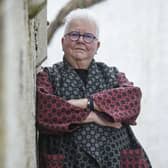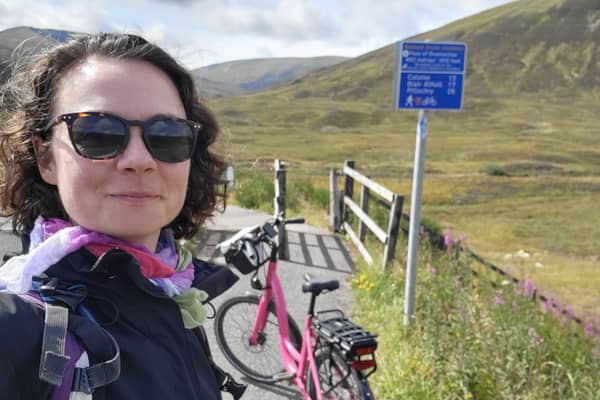
AT A TIME WHEN MOST people are trying to slow down the pace of their lives, Jacquetta Megarry could be described as a thrill seeker. A latecomer to trekking and climbing, the 59-year-old grandmother gained a passion for mastering mountains after tackling the West Highland Way in Glencoe when she was in her early fifties.
This initial, and comparatively tame, adventure inspired a trip to ascend Mount Kilimanjaro in Tanzania, four miles above sea level, which she has now climbed on three separate occasions by different routes.
A Londoner by birth, Jacquetta moved t
o Scotland to be with her husband Keir, and has been here for nearly 30 years, the last 14 in Dunblane.
"When I was younger I lived in the city and was more into fast cars, motorbikes and parties," she says. "From where I live, just above Dunblane, we can see 13 Munros, many of which are snow-capped at present. I don't do Munro-bagging, but as part of living in the country and having dogs you naturally tend to walk."
Jacquetta sees being over 50 as having more pros than cons when it comes to climbing. "At a younger age climbing would have been less challenging physically, but at altitude, the most important organ is not your legs, nor even your heart and lungs: it's your brain.
"Being older means being more mature, not feeling competitive and, in my case, not even being fit enough to rush up the mountains too fast."
During her expeditions she discovered a lack of practical, weatherproof guides and so gave up her career as a training consultant to set up her own publishing company, Rucksack Readers, which has now produced 14 colour guidebook titles. She researches and writes most of the books herself, and in recent years her work has taken her everywhere from the Great Wall of China, to the Inca Trail and Aconcagua in South America. She's also covered most of Scotland's and Ireland's well-known long distance walking routes, including the Cateran Trail and the Wicklow Way.
Jacquetta's next project involves acting as a guinea pig in the Xtreme Everest medical research programme run by University College London. When an opportunity arose to join 1,000 volunteers undertaking medical tests at altitude at Kalapattar, the base camp of Everest, she jumped at the chance.
"I'm fascinated by the effects of altitude, and despite being older than many others on various expeditions I find I seem to be less prone to altitude sickness than the young men who I've been in groups with on Kilimanjaro.
"They are keen and fast on the first few days, while I just plod along at the back. Yet on summit day, I might be way up ahead while some of them are throwing up, exhausted, and never get near the summit. This has happened to me three times so far, but of course, in Nepal it might all be different, it's very unpredictable and could be down to genetics, gender or body shape."
The £1.5 million Xtreme Everest research programme is studying the effects of altitude on the human body and will include setting up the world's highest medical lab, on the summit of Everest, to measure levels of oxygen in the blood. While the volunteers remain at base camp, a select team will ascend to the 29,028ft peak of Everest. The volunteers stationed at Kalapattar range in age from 18 to mid-seventies, and none are professional athletes. They'll undertake a series of arduous tests designed to study the effects of different levels of hypoxia (low blood oxygen) on the body. Hypoxia can affect blue babies, cystic fibrosis sufferers and people with severe heart and lung conditions.
Jacquetta reckons training for the unpredictable isn't easy: "Hillwalking is the best training for hillwalking, but sadly you can't train for altitude without being at altitude," she says. "I've done a bit in the gym recently because the weather has been so foul, and nearer my departure for Nepal on 7 April I'll try to get out in the hills once a week, but with my job it's a struggle to carve out the time."
And what does her family make of Jacquetta's adventures?
"My husband thinks I might be off my trolley. I occasionally suggest he joins me, but it's not for him. My family are very tolerant of my trips and assume that everything will go well. They're very trusting".
For more information on Rucksack Readers, visit
www.rucsacs.com For more information on Xtreme Everest, visit
www.xtreme-everest.co.uk